
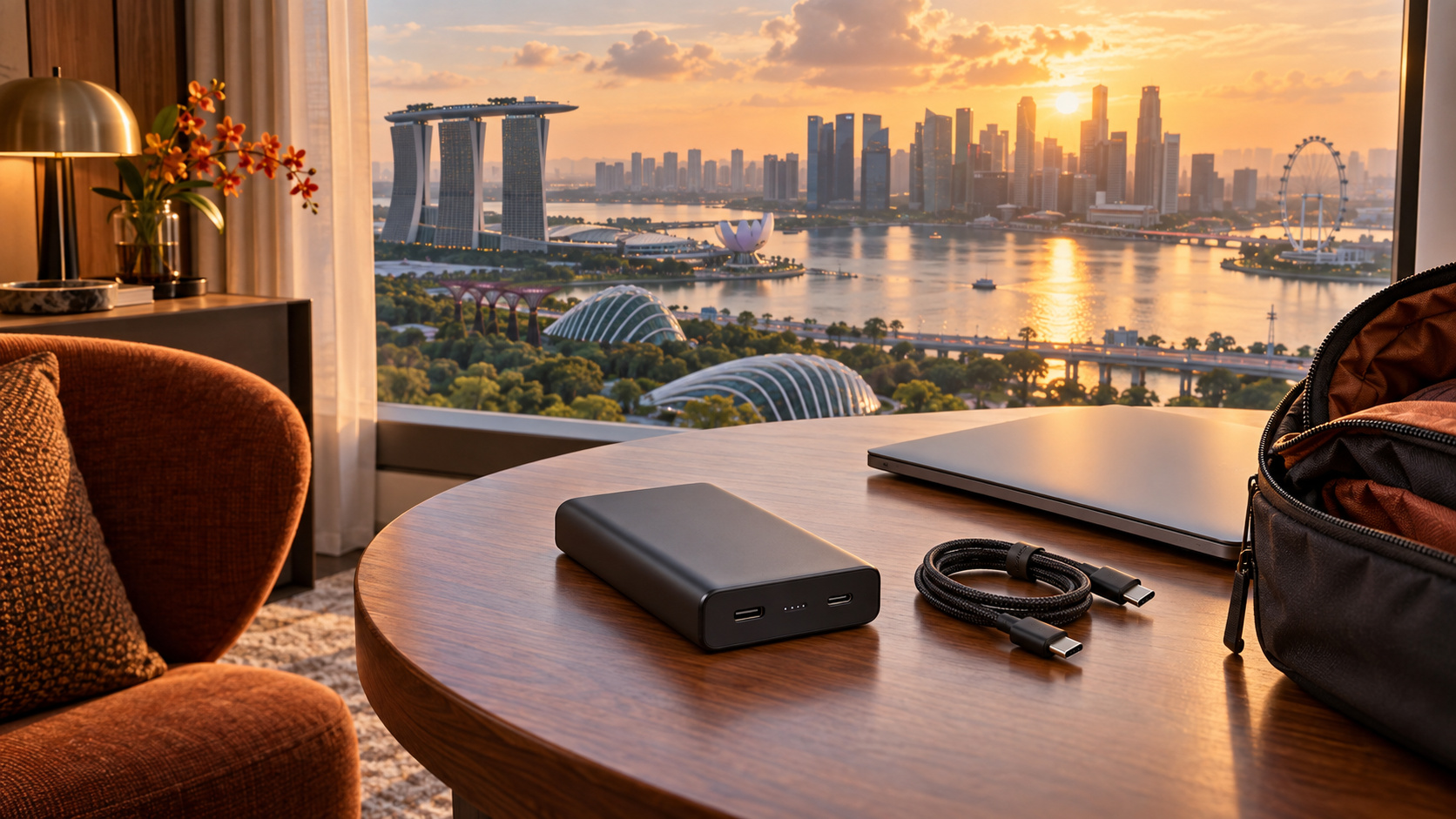
You’re at the gate, your phone or compatible USB-C laptops battery is running low, and the charger in your bag suddenly comes with a rule you didn’t know about. Getting a power bank through security doesn’t mean you can use it on the plane.
Verdict: For straightforward travel, choose a clearly labeled power bank at or below 100 watt-hours (Wh), carry it in the cabin, and check the operating airline’s policy. In 2026, capacity is only part of the decision. Quantity, storage and onboard use matter too.
Can you bring a power bank on a plane?
Yes, subject to battery limits and airline restrictions (which vary from country to country). Power banks count as spare lithium batteries, so they belong in your carry-on, never checked luggage. If your bag gets gate-checked, remove the power bank first. Protect it from damage and short circuits (FAA battery guidance).
Under U.S. rules, batteries up to 100 Wh generally need no airline approval. Larger batteries above 100 Wh and up to 160 Wh require approval, with a limit of 2 spares; above 160 Wh is prohibited. Airlines and international rules can be stricter. That approval route isn’t a promise that your airline accepts a larger power bank.
What changed in the 2026 airline power bank rules?
ICAO’s new specifications, effective March 27, 2026, limit passengers to 2 power banks and prohibit recharging those banks during flight. Recharging the bank and using it to charge your phone are different actions.
Airlines can add tighter restrictions. Southwest’s current policy allows only 1 power bank per passenger, effective April 20, 2026, capped at 100 Wh. It cannot go in the overhead bin or recharge from in-seat power; when used, it must remain visible. Virgin Australia prohibits using power banks onboard to charge devices.
Check each operating carrier on a connecting itinerary. A bank accepted on the first leg can still run into a different policy on the next.
Check watt-hours, not just mAh
The printed Wh rating is the useful number. Watts describe charging output; watt-hours describe stored energy. A 250W charger isn’t a 250Wh battery.
If you need to calculate capacity, use Wh = (mAh ÷ 1,000) × nominal battery voltage. At 3.7V, a 20,000mAh bank is 74 Wh. Use the manufacturer’s stated cell voltage, not the USB output voltage, and don’t substitute your calculation for a readable label. If the calculation is annoying, a well phrased google search can be just as effective.
2 laptop power banks below 100 Wh
The Anker Prime 20,100mAh (220W) makes sense for a laptop-and-phone kit when you need more than a small phone charger. Anker lists its capacity at 72.36 Wh. Its 220W headline describes total output, not what every device receives. Check your laptop’s USB-C charging requirements and cable before buying; this is more charger than a phone-only trip needs (unless you are charging a families worth of devices).
The Anker Prime 27,650mAh (250W) is the larger option, rated at 99.54 Wh in the supplied listing. Anker’s specifications list a 665g weight and up to 140W from a USB-C port. That extra capacity adds noticeable bag weight. Choose it for a compatible laptop away from outlets, not because its rating sits close to the limit. Neither bank guarantees permission to use it onboard.
Who should skip buying a new charger?
Keep your existing bank if its label, condition and capacity meet your airline’s policy. Check the model against the manufacturer’s recall list; damaged or recalled batteries should not travel. A larger bank also won’t solve an airline’s ban on onboard use.
Before departure, charge your devices, verify the airline’s quantity and storage rules, and put the bank somewhere you can reach if your cabin bag gets checked. Do that at home, while you still have an outlet and options.
Cited sources
- FAA: FAA battery guidance.
- ICAO: ICAO’s new specifications.
- Southwest: Southwest’s current policy.
- Virgin Australia: Virgin Australia.
- Anker: Anker lists its capacity at 72.36 Wh.
- Anker: Anker’s specifications.
- Anker: manufacturer’s recall list.
More field guides
More Remote Office guides
Offline AI and a Pocket Library: Keep Working When the Wi-Fi Dies
Set up local AI, offline Wikipedia and downloaded maps before an outage. Know what belongs on a portable drive, what stays on your phone, and what to test.
Read the field guide
Gifts for Someone Who Works From Home (or From Anywhere)
Useful gifts for remote workers, chosen around their actual desk or travel bag: practical picks, compatibility checks, and the gifts to ask about first.
Read the field guide
Coffee Shops Limiting Laptops? Build a Work Bag That Goes Anywhere
Build a work-from-anywhere bag with laptop fit checks, useful remote work essentials and a clear choice between Peak Design Everyday 20L and North Face Recon.
Read the field guide