
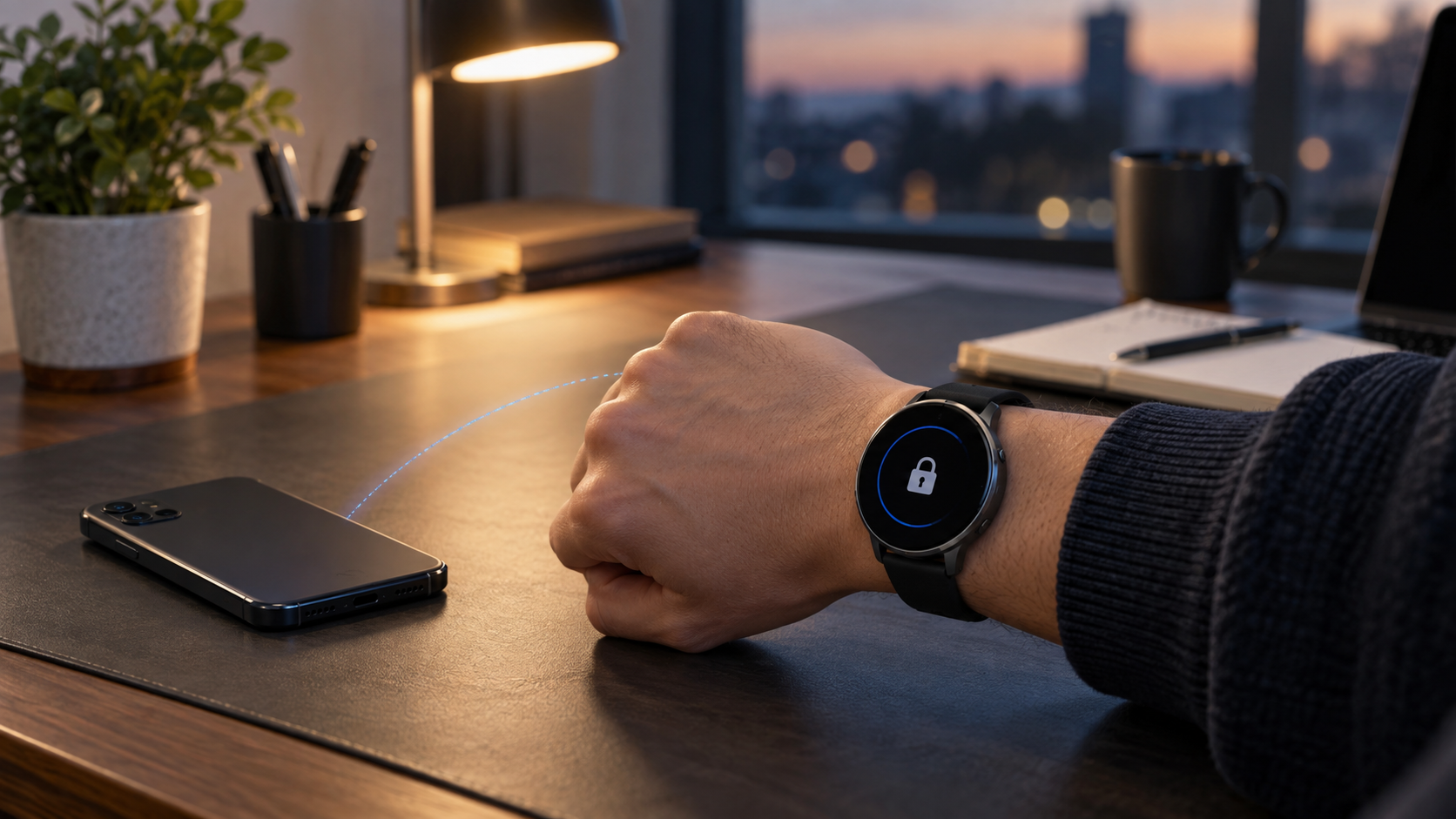
In 2018, a fitness app’s public heat map exposed patterns around military installations. The watches had not been “hacked by Bluetooth.” People recorded routes, the app uploaded them, and millions of traces became revealing when viewed together.
That distinction matters. Smartwatch conversations often collapse radiofrequency exposure, Bluetooth security and cloud privacy into one vague fear called “radiation.” They are related only because the same object sits on your wrist.
The short verdict: current evidence does not establish that the low-power radiofrequency signals from Bluetooth wearables cause health harm. The privacy risks are easier to demonstrate, but airplane mode only addresses one part of them. If you want less transmission without giving up tracking, record locally and sync deliberately.
“Radiation” is doing too much work
Bluetooth, Wi-Fi and cellular connections use non-ionizing radiofrequency energy. It does not carry enough energy to ionize atoms in the way X-rays can. That does not make every exposure automatically harmless, but it does mean comparisons with ionizing radiation are misleading.
Bluetooth devices generally transmit at far lower power than mobile phones. Exact exposure still depends on the device, distance, duty cycle and how often it communicates. A smartwatch may exchange small packets throughout the day, while a cellular watch can use a higher-power connection when it is operating away from a phone.
GPS is another common source of confusion. A watch listens for one-way satellite timing signals. GPS satellites do not receive your route from the watch. Your location becomes a privacy issue when the watch shares it with a phone, app or cloud account.
What the health evidence does and does not say
The International Agency for Research on Cancer classified radiofrequency electromagnetic fields as “possibly carcinogenic” in 2011. That is a hazard classification, not proof that smartwatches cause cancer, and it was based largely on limited evidence involving wireless-phone use.
A 2024 World Health Organization-commissioned systematic review of human observational studies found moderate-certainty evidence that mobile-phone radiofrequency exposure likely does not increase the risk of several brain and head tumors. It was not a smartwatch study.
A separate 2025 systematic review of animal studies reported high-certainty evidence of increased gliomas and heart schwannomas in male rats in some chronic exposure experiments. Animal evidence can identify a biological hazard under the tested conditions, but it does not by itself measure the risk from a low-power device worn on the wrist. Taken together, these reviews do not justify a claim that smartwatch Bluetooth is either proven dangerous or proven harmless in every circumstance.
Australia’s radiation regulator says there is no substantiated evidence of health effects from wearable devices. The WHO’s broader radiofrequency health assessment is still in development. That is a less dramatic answer than either side usually wants, but it is the honest one.
The privacy problem is easier to see
Wearables can collect location, sleep, heart-rate and routine data. The practical risks include permissive sharing defaults, account compromise, long retention periods and aggregation that reveals patterns no single workout exposes.
A 2023 academic study examined 6 smartwatch models across 7 phone pairings. It found 2 pairings without authentication and 6 devices using static Bluetooth addresses, which can make tracking easier. The sample was small and model-specific; it does not prove that every current watch is insecure. It does show why software support and privacy settings deserve the same attention as the sensor list.
Airplane mode reduces the active wireless attack surface while it is on. It does not delete stored data, change an app’s privacy policy or retract workouts already uploaded.
A practical default
- Turn off notifications and background features you do not use.
- Review location visibility, profile visibility and connected apps.
- Use a unique password and multi-factor authentication where available.
- Record workouts with Bluetooth, Wi-Fi and cellular disabled when constant sync adds no value.
- Reconnect intentionally, upload what you want, then switch wireless off again.
Who should skip wireless-off use
People who rely on fall detection, emergency calling, live location sharing or phone-free cellular contact should think carefully before disabling radios. Those functions may matter more than reducing transmissions.
See Low-EMF Fitness Watches: Offline Tracking With Wireless Off for watch-by-watch recording and sync trade-offs. For the same decision pattern in another room, see How to Watch TV Without Letting the TV Watch You in 2026.
Last verified: September 15, 2026. This is an evidence review, not medical advice.
Sources
- IARC: Radiofrequency electromagnetic fields classification
- National Cancer Institute: Cell phones and cancer risk
- ARPANSA: Wearable devices
- 2024 systematic review of human observational studies
- 2025 systematic review of animal studies
- WHO: Radiofrequency fields health risk assessment
- U.S. Department of Defense: Wearable-device heat-map review
- Sensors: Security and privacy analysis of smartwatch pairings
- GPS.gov: GPS Frequently Asked Questions
More field guides
Research the next purchase
Choose the room or problem you are working on next.
Browse all guides