
You keep telling yourself you will train once you have the space. A garage, a basement, the spare room you do not have. So the setup never happens, and the months add up.
The verdict up front: a strength setup that covers every major lift fits in about 50 square feet, roughly a 7 by 7 patch of floor, with room to move in it. The trick is not cramming. It is refusing to buy anything that does not earn its footprint. In a small space, one adjustable tool that replaces a whole rack is worth three times its price. This is general information and not medical or fitness advice. Please read our Health & Medical Disclaimer and talk to a professional before you start a program.
The three purchases that do almost everything
- Adjustable dumbbells. The single best small-space buy. One pair spins from light to heavy in a couple of seconds and replaces a rack that would eat an entire wall. This anchors the room.
- An adjustable bench. Flat, incline, and decline in one folding frame opens up presses, rows, and dozens of movements. Buy one that folds so it stores against a wall.
- A pull-up bar. A doorway or wall bar adds the entire pulling half of training for almost no floor.
With those three you can load every major pattern: pressing overhead, pulling to the bar, hinging, and squatting. Most people never outgrow them at home.
The high-value additions
- Resistance bands. Near-zero footprint, and they cover warm-ups and accessory work a dumbbell cannot reach at the bottom of a rep.
- An adjustable kettlebell. Swings, carries, and conditioning in one dial-a-weight unit instead of a row of bells.
- A suspension trainer. Anchors to the same pull-up bar and turns your own bodyweight into resistance.
Do not skip the floor
Flooring is what makes a closet gym survivable, especially in an apartment. The first time a loaded dumbbell hits bare hardwood, you will hear about it from the neighbor below. Dense rubber tiles or a stall mat under the working zone protect the floor, kill the noise, and give you stable footing under load.
Storage that disappears
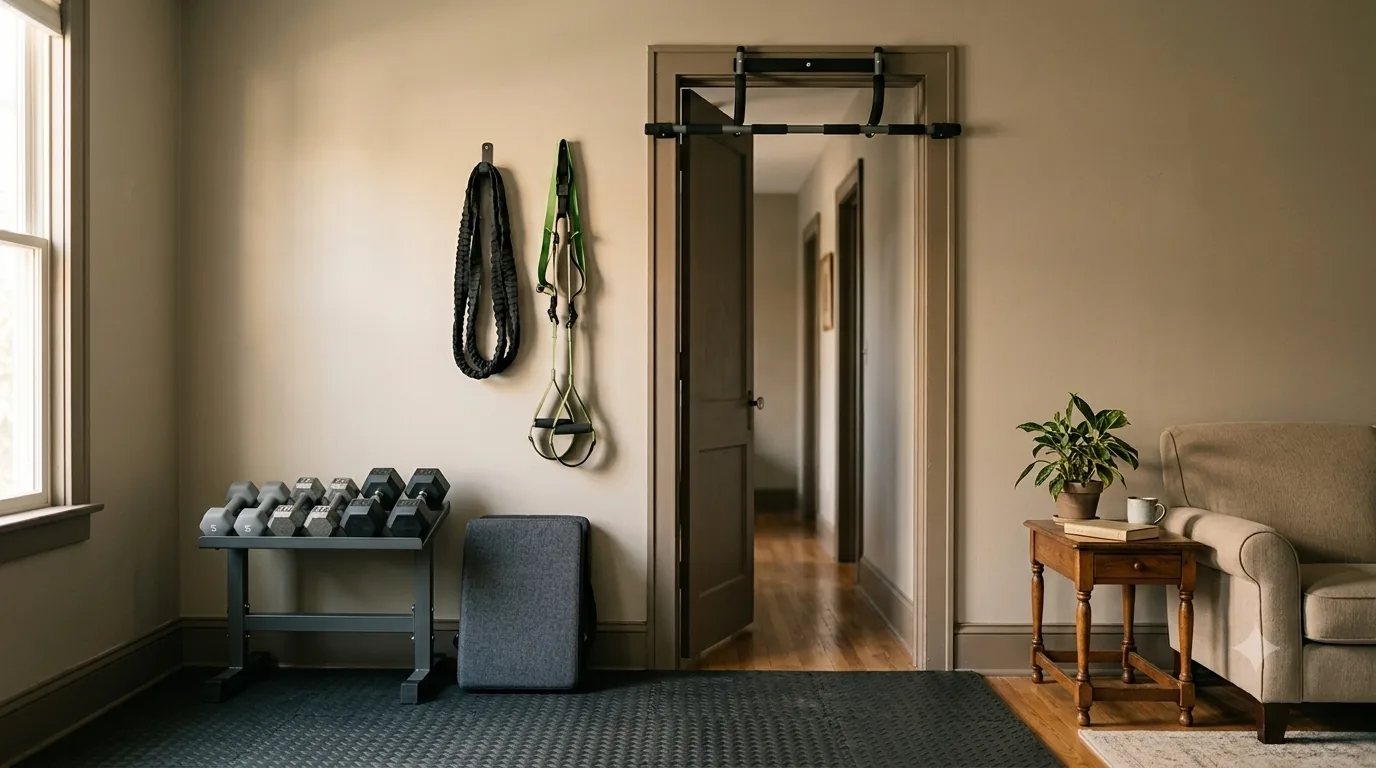
The room only stays at 50 square feet if everything has a home the moment you finish. A narrow vertical rack for the weights, wall hooks for bands and the suspension trainer, and a bench that folds flat keep the space livable between sessions. Build up, not out.
A sample 7 by 7 layout
Rubber tiles cover a 6 by 4 working zone. The adjustable dumbbells and kettlebell sit on a low rack against one wall. The bench folds and leans beside it. The pull-up bar mounts in the doorway or on the wall above. Bands and the suspension trainer hang on two hooks. The whole thing lives under 50 square feet and resets in under a minute.
What you do not need
Skip the full power rack, the fixed dumbbell set, the treadmill, and most single-function machines. They swallow floor space and duplicate what your adjustables already do. In a small gym, restraint is the strategy, not a compromise.
Who should skip this setup
If you are chasing a competitive barbell total, you will eventually want a rack and a platform, and that needs a garage. For getting genuinely strong in a home you actually live in, the footprint above is enough.
We choose this gear for durability, space efficiency, and value at each price, and we recommend it independently. See our Editorial & Review Policy. Start with the three anchors and add from there as the habit sticks.
More field guides
Research the next purchase
Choose the room or problem you are working on next.
Browse all guides